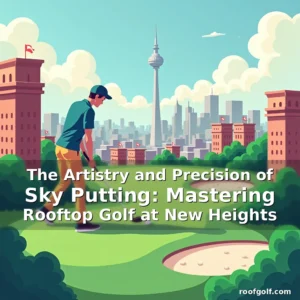

The Art of Sky Putting: Mastering Elevated Golf Challenges
Sky putting is an exhilarating variation of golf that challenges players to navigate the complexities of elevated terrain. This unique form of putting requires not only traditional golf skills but also adaptability and precision when dealing with height differences. As the popularity of rooftop golf courses continues to grow, mastering sky putting has become essential for any serious golfer looking to elevate their game.
Whether you’re practicing on a city skyline terrace or tackling a high-altitude course, understanding how elevation affects your putts can transform your performance. With the right techniques and equipment, even seasoned professionals find themselves re-evaluating their approach to this specialized aspect of the sport.
Understanding the Unique Dynamics of Sky Putting
At its core, sky putting involves executing putts from elevated positions such as rooftops, balconies, or other high places. These environments introduce new variables that significantly impact ball behavior compared to standard green conditions. The primary challenge lies in adapting to changes in gravity’s effect and wind patterns at higher altitudes.
Unlike conventional putting surfaces, elevated areas often have irregularities that affect both roll and trajectory. Factors like surface texture, slope variations, and proximity to building edges create unpredictable playing conditions. Players must develop strategies specifically tailored to these unique environmental factors.
- Altitude Effects: Higher elevations reduce air density, which alters how far the ball travels before coming to rest. This means distances may differ by up to 15% depending on altitude levels.
- Wind Influence: Wind speeds tend to increase with height due to reduced friction near ground level. A consistent breeze at eye level might translate to stronger gusts affecting the ball’s path.
Gaining proficiency in reading skiescape greens becomes crucial for successful sky putting. Unlike regular greens where grass composition provides visual cues about speed, elevated surfaces require different interpretation methods based on material type and surrounding structures.
A key technique involves analyzing how shadows cast across potential putting lines reveal subtle slopes invisible under direct sunlight. Learning to recognize micro-slopes through shadow analysis helps refine accuracy over time. Practicing with various materials – concrete, wood, metal – enhances versatility across different rooftop environments.
Players should also consider how reflective surfaces around them interact with light sources during different times of day. Morning dew on metal railings versus midday glare off glass facades creates distinct visibility challenges that influence line choice and distance estimation.
Mental Preparation for Elevated Play
Maintaining mental clarity while navigating challenging elevated terrains is vital for optimal performance in sky putting. Psychological readiness plays a significant role in overcoming spatial disorientation caused by unusual vantage points.
Establishing pre-shot routines adapted to vertical perspectives helps maintain consistency. Visualizing the entire putting motion from above rather than horizontally trains the mind to anticipate trajectories accurately. Incorporating mindfulness exercises improves concentration amidst potentially distracting urban landscapes.
Cultivating confidence through gradual exposure builds resilience against pressure situations. Starting with shorter putts allows players to build muscle memory without overwhelming sensory input from complex surroundings.
Developing a strong mental framework includes setting realistic expectations about what constitutes success in this specialized format. Recognizing that perfect execution isn’t always possible on uneven surfaces fosters a healthier competitive mindset.
Equipment Considerations for Sky Putting
Selecting appropriate gear is critical when engaging in sky putting activities. Standard golf clubs may not provide sufficient control given the unpredictable nature of elevated surfaces. Specialized equipment designed for rooftop play offers enhanced stability and maneuverability.
Balancing weight distribution within clubheads proves particularly beneficial when striking balls from precarious edges. Clubs with lower centers of gravity help maintain better contact despite minor misjudgments in positioning. Ergonomic grips designed for varied hand placements accommodate awkward angles common in elevated settings.
Ball selection deserves careful consideration as well. Balls engineered for high-speed rotation perform differently on hard surfaces typical of rooftops. Testing various models helps identify those offering best control characteristics for specific types of elevated terrain.
Protective gear remains equally important for safety reasons. Non-slip shoe soles prevent accidental slips on smooth surfaces, while wrist guards protect against unexpected vibrations from solid strike impacts. Investing in quality protective equipment ensures both physical safety and enhanced performance capabilities.
Technique Refinement Through Practice Routines
Consistent practice forms the foundation for mastering sky putting techniques. Structured training sessions focused on specific aspects of elevated play accelerate skill development. Designing personalized drills addresses individual weaknesses while reinforcing fundamental principles.
Varying target distances exposes players to different gravitational influences inherent in aerial putts. Practicing short-range shots develops fine motor control necessary for precise touch. Long-distance attempts build confidence handling larger movements required for greater spans.
Incorporating obstacle-based scenarios simulates real-world challenges encountered on actual rooftop courses. Navigating around protruding objects hones spatial awareness and quick decision-making abilities. These simulated obstacles range from fire escapes to antenna arrays commonly found in urban environments.
Using alignment aids assists beginners in establishing correct body orientation relative to intended putting paths. Laser guides mounted on shafts provide visual references ensuring accurate directional setups regardless of player position relative to the target.
Tracking progress through video recordings enables objective assessment of technical improvements over time. Analyzing footage reveals unconscious movement patterns that hinder efficiency, allowing targeted corrections toward optimal mechanics.
Engaging in peer review sessions encourages collaborative learning among fellow enthusiasts. Observing others’ approaches highlights alternative solutions worth exploring. Constructive feedback facilitates faster refinement cycles leading to accelerated mastery.
Environmental Awareness in Sky Putting
Heightened sensitivity to environmental factors distinguishes skilled sky putters from casual practitioners. Understanding how external elements influence gameplay leads to more strategic decision-making. Monitoring weather conditions provides crucial information about impending challenges.
Temperature fluctuations alter material properties impacting ball interaction. Colder temperatures stiffen surfaces reducing bounce effects whereas warmer conditions soften materials increasing rolling resistance. Adjustments in stroke tempo account for these thermal variances effectively.
Humidity levels affect both air density and surface moisture content simultaneously. Increased humidity reduces effective swing arc length requiring slight modifications in follow-through depth. Wetter surfaces demand more deliberate acceleration phases to ensure complete contact engagement.
Precipitation introduces additional complexity requiring immediate tactical adjustments. Rain softens most surfaces creating inconsistent bounce behaviors. Sudden downpours necessitate rapid recalibration of expected outcomes based on current conditions.
Seasonal variations present ongoing challenges demanding continuous adaptation. Springtime growth on adjacent structures modifies available putting corridors requiring constant reassessment of viable routes. Autumn leaf accumulation temporarily transforms flat surfaces into textured playing fields altering normal dynamics.
Navigational Strategies for Complex Rooftop Terrains
Successfully navigating intricate rooftop layouts demands advanced navigational skills beyond basic directional awareness. Mapping out potential pathways ahead prevents unnecessary detours wasting precious strokes. Identifying safe zones minimizes risk exposure during delicate putts.
Recognizing structural features serves as natural landmarks guiding movement through complex spaces. Columns, staircases, and maintenance ladders function as reference points aiding spatial orientation. Familiarity with architectural layouts streamlines route finding processes dramatically.
Evaluating clearances between objects determines feasible aiming directions. Assessing minimum buffer zones protects against unintended collisions compromising shot integrity. Maintaining adequate margins accounts for inevitable human error in judgment calls.
Anticipating maintenance activity schedules avoids disruptions to planned play sequences. Coordinating access times with facility managers ensures uninterrupted practice sessions free from unexpected interruptions. Establishing rapport with caretakers facilitates smoother operations overall.
Planning escape routes in advance safeguards against unforeseen complications arising mid-play. Having alternate paths ready maintains momentum even when initial approaches prove unworkable. Preemptive contingency planning prevents costly delays affecting overall performance metrics.
Fostering Community Engagement Through Sky Putting
Building connections within the sky putting community enriches the experience for participants at all levels. Shared knowledge accelerates personal development through collective wisdom. Organizing group practices cultivates camaraderie while promoting healthy competition spirit.
Creating local leagues establishes structured opportunities for regular engagement. Competitive formats encourage disciplined preparation while fostering friendly rivalries. Tournament series offer recognition platforms highlighting exceptional talent emerging from grassroots participation.
Hosting educational workshops disseminates expert insights benefiting newcomers seeking foundational guidance. Mentorship programs pair experienced players with novices facilitating knowledge transfer efficiently. These initiatives strengthen communal bonds through mutual support systems.
Collaborative research efforts contribute to broader understanding of elevated play nuances. Documenting observations systematically generates data supporting future innovations. Sharing findings openly promotes continuous improvement across the entire sky putting ecosystem.
Virtual communities extend geographical boundaries enabling global interactions. Online forums facilitate idea exchange transcending regional limitations. Digital platforms allow remote collaboration expanding possibilities for shared experimentation and innovation.
Organizing charity events leverages enthusiasm towards meaningful causes. Fundraising tournaments combine recreation with social responsibility. Such endeavors demonstrate the positive societal impact achievable through recreational pursuits.
Future Innovations in Sky Putting Technology
Ongoing technological advancements promise exciting developments transforming sky putting experiences. Emerging tools enhance training effectiveness while improving accessibility for wider audiences. Integrating digital analytics provides deeper insights into performance optimization avenues.
Smart sensors embedded within practice mats collect biometric data revealing inefficiencies in technique. Real-time feedback mechanisms enable instant correction of flawed motions. These devices revolutionize self-assessment capabilities previously limited by observational constraints alone.
Augmented reality applications overlay virtual targets onto physical spaces enhancing visualization capabilities. Interactive simulations allow experimenting with theoretical scenarios safely. Gamification elements add motivational incentives encouraging sustained engagement with training regimens.
Drones equipped with measurement capabilities assist in assessing course dimensions remotely. Three-dimensional mapping technologies generate detailed topographical analyses useful for strategy formulation. These innovations streamline preparatory phases significantly reducing manual labor requirements.
Wearable technology tracks physiological responses indicating stress indicators influencing performance consistency. Heart rate monitors detect anxiety spikes prompting timely interventions maintaining composure levels. Such biofeedback systems promote holistic wellness approaches integral to peak performance states.
Artificial intelligence algorithms analyze vast datasets identifying pattern trends suggesting personalized development plans. Predictive modeling forecasts potential issues enabling proactive problem solving. These computational tools democratize expertise making elite-level coaching accessible universally.
Conclusion
Sky putting represents a fascinating evolution in golfing traditions embracing modern challenges presented by elevated environments. By combining traditional fundamentals with contemporary adaptations, players discover new dimensions of the sport they thought were already mastered.
Embracing this innovative format opens doors to fresh experiences revitalizing passion for the game. Whether exploring rooftop sanctuaries or pioneering novel techniques, every practitioner contributes uniquely to shaping the future landscape of elevated golfing adventures.